Tag: Chattahoochee

  • Grammy’s Heavenly Homemade Biscuits – Chattahoochee Child

    Grammy’s Heavenly Homemade Biscuits – Chattahoochee Child


    Yesterday while reading an e-mail from an online writers’ group, I discovered a food writing contest. The directions discussed a contest for Thanksgiving. The assignment was to share a family recipe for the holidays. Humph. I thought. I don’t have any family recipes to share.

    That assignment for a contest got me thinking; nevertheless, I cannot enter the competition, simply because the recipe I would share would be Grammy’s homemade biscuits.

    My Grammy was a good ole’ Southern cook, rarely did she measure anything. Her recipes were never written on index cards for others to share or to preserve for family members. A tiny woman, with long white hair, early every morning she rolled her hair up in a crochet hair bun, clipping the left and right with wavy clips. Spraying the hair with a light spray, she was ready for the day. No makeup or fancy earrings did she wear. She was a natural beauty with bright, beautiful blue eyes.

    Grammy encouraged me to help her in the kitchen. “Always remember to wash your hands several times when cooking,” she said. Only 10 years old, I remember stepping up on a chair to watch her make baked goods, especially her homemade biscuits. Grammy had a special large pottery bowl only used for baked goods. In this bowl, she placed all-purpose flour, Grammy preferred Gold Medal Flour, baking powder, a bit of salt, shortening, Grammy preferred Crisco, and milk.

    I watched my grandmother carefully; curious as to how she knew just the right ingredients to use to bake the light as a cloud, fluffy hot biscuits she made daily. Never did she measure the ingredients. Never did she make a mistake.

    “Grammy,” I said, watching her fingers moving the ingredients into a soft, moist mixture that rolled into one soft ball of dough, ready to pinch off and pat into a cast iron skillet. “How do you know how much to use? You always make the best biscuits. They melt in my mouth.”

    Grammy laughed. “I just know.”

    “But you don’t measure anything. If I tried to make these, how would I know?”

    Grammy laughed again, her blue eyes almost dancing with delight.

    “Well child, I suppose I’ll share my recipe.”

    Grammy’s Homemade Biscuits
    “Use a large pottery bowl that you only use for biscuits.
    Place a bunch of flour in the bowl. If you are making biscuits for our group, a family of 10, then you place a lot of all-purpose flour in the bowl.
    Add a pinch of baking powder.
    A dash of salt.
    Shortening. I always use only Crisco, and if I’m baking biscuits for all of us, including Rusty, I use more Crisco and more ingredients.
    Milk. I don’t like it real cold. I let it get a bit warmer before I use it. I let it sit out for about five minutes before I pour it in. Before I pour it in, I make a well with the ingredients with my fingers and I pour the milk into the well. Then I mix it all up.
    I have the oven ready by letting it heat up a bit. The temperature is warm, about 400 degrees when I put the biscuits in the oven. My secret to get golden biscuits is to roll a bit of the dough in your hands to make the shape and size you want and place each biscuit in the pan. Pat each biscuit in the skillet with milk. That helps them to get golden brown and stay moist.”

    I listened and listened while wondering what a bunch of flour was. A pinch of baking powder. A dash of salt. Enough Crisco for all of us, including Rusty? And – just HOW would the biscuit bowl KNOW it was only used for biscuits, nothing more?

    I shook my head. I would never be able to bake Grammy’s homemade biscuits.

    When I was a teenager, our family fell apart. My mother and father divorced. Mom moved us back to Bibb City, to live with our grandparents. Cramped together in a small brick mill house with only two bedrooms, one bathroom, and a tiny kitchen, I chose to devote my time to cooking. I asked Grammy to teach me how to bake biscuits. Following her directions, I scooped up a bunch of flour. My fingers pinched the baking powder. I shook the salt shaker, hoping to get just a dash of salt to make my biscuits as fluffy and tasty as Grammy’s. I took a large measuring cup filled with Crisco, plopping it into the well of the flour mixture. And then, my fingers worked their magic, pouring in just enough milk to make the ingredients work together into a magical ball. The ball my mixture made was lumpy and dry.

    Working my fingers around the well of dough, I hoped and prayed my mixture would follow the lead of Grammy. I moved my fingers strategically, just like Grammy. The mixture refused to follow my lead.

    “Grammy,” I said. “My biscuit dough doesn’t move around the bowl like yours did. What did I do wrong?”

    Grammy looked at the table, noticing the measuring cups.

    “I don’t measure, child. I just scoop it all up in my fingers.”

    “Oh…but how…how do you know what a bunch of flour, a pinch of baking powder, a dash of salt and enough Crisco is? Did I mix too much milk in my well?”

    She laughed. “You just know child. Don’t fret none. It’ll come to you.”

    For two more days I attempted to learn how to bake Grammy’s homemade biscuits. On my last attempt, Grammy suggested I stick with baking my homemade pound cakes. A Betty Crocker recipe, I make those pound cakes every year, and each time I do how I wish I had my Grammy’s vintage pottery bowl.

    I lost my grandmother to breast cancer in 1973. Unfortunately, her recipe for homemade biscuits vanished with her death. Today, I suppose it is to my benefit that I do not have that delicious recipe, or her magical vintage bowl. One can only imagine how such recipes require willpower, just to abstain from eating them – at every meal.

    I have no idea what happened to that beautiful biscuit bowl. Never did I receive anything tangible in remembrance of my precious grandmother. I do hope someone in the family has it, although I doubt it. My mother had the tendency to take such precious items to antique shops to sell. Perhaps the next time I go ‘antiquing’ I will search for such a bowl. If my memory is correct, the bowl was an off-white color, deep with two blue bands across the width of the bowl. A bit heavy for a young child, but I cherished that bowl, along with my grandmother.

    During the holidays I still crave my grandmother’s homemade biscuits. No one that I know has ever been able to equal her magic recipe. I suppose some recipes should remain secrets for the family to enjoy. The next time you eat a homemade biscuit, just pretend you are eating a light, golden brown biscuit – from Heaven, in memory of my Grammy!

  • Friday Reflections…

    Friday Reflections…


    Dearest Readers:

    If you follow my blog on a regular basis, you will know I haven’t written much in this column in about two weeks. Last week was truly the week from Hell for me. Beginning with suspected car problems where the technicians replied, “The engine light wasn’t on when we checked it…” Of course, that is a typical response from men to a woman at a service department…now, isn’t it — WOMEN! They were slightly mistaken. The engine light icon returned, and on Wednesday, it took over three hours to get it repaired. Of course, the main reason it took so long is due to the fact my car warranty was purchased with the car ($1549.00) at Car Max. Still, I am furious with Car Max; however, I will go on record to say that the service tech at Dodge possessed an amazing amount of patience with them — JUST — to get the warranty approved. Thank you, Dodge…and NO THANK YOU…to Car Max!

    But — that chapter is closed and I am pleased to share that the repair that I had to pay for in the amount of $477.21 has been compensated to me – minus the $100 deductible since I DID NOT USE CAR MAX FOR THE REPAIR… Heck, I could not get Car Max to return a phone call, or the Mouse Lady to acknowledge me! Can you detect my frustration with Car Max???

    Enough about Car Max! I suppose this post should actually be Friday frustrations, instead of Friday Reflections; however, since I am a person who looks for the positive in life and not the negative, I will do my best to reflect with a positive attitude.

    While I am reflecting on Friday and this week, I would like to share that I was finally able to attend my weekly Weight Watchers meeting yesterday — the first meeting I’ve attended in four weeks. I confess, I anticipated a weight gain of 3 or 4 pounds and was a bit happy when I had only gained .06! It was wonderful to get back to my REAL life again. This reflection proves to me that I cannot complete my Weight Watchers journey alone. Like someone with an addiction, I must attend weekly meetings to share my ups and downs with all. I confess, I think the only reason I did not show a weight gain of four pounds or more was due to the fact that I have worked out on the treadmill every day since last Saturday. It was suggested at the meeting for me to ‘shake up’ my exercise routine a bit, so this week I will go for an extended walk — on the Arthur Ravenel, Jr. Bridge, and I will return to walking my dogs again. I’ve been slack about walking my dogs ever since we lost my precious Shamey-Pooh. The last time I walked the dogs on our three-mile journey someone actually stopped me to inquire where the ‘beautiful silver dog was,’… when I replied that he died, they apologized and I burst into tears.

    Undoubtedly, there has been a black cloud over me for a few weeks, or maybe it is the full moon returning; nevertheless, this week started off — shall I say unpredictable. Monday afternoon, Phil and I left the house a few minutes after 5pm, headed to the Coastal Carolina Fair. What would normally take about 30 minutes was at least 1.5 hours. We arrived at the fair at about 7pm. Never did Phil get annoyed about the traffic and we had a great time at the fair. Little did I know how things would change within 24 hours!

    For those of you who do not know – My husband has PTSD – Post Traumatic Stress Disorder. If you do not know what it is like to live with someone with PTSD — count your blessings! Tuesday afternoon when Phil returned home from work, he had a strange look in his eyes. I know that look well — PTSD! Within 30 minutes, we were fighting. I cannot recall what set him off, or me off – but our fight continued. I decided to shut myself away in the bedroom. That night, I broke our rule – a rule made when we were newlyweds…the rule of “never going to bed angry, or without a good night kiss!”

    Wednesday – we had the same scenario. No matter what I said, we could not stop the fight. Listening to someone is difficult with him. I approached him carefully, telling him ‘we need to talk.’ When someone has PTSD communication does not exist. Every time I said I needed to talk to him, we fought. The real kicker was when Phil shouted to me that I was exactly like my mother. Yes, he does know the right buttons to push! I exploded although with a calm, diplomatic voice letting him know that I was ‘nothing like my mother!’ Never did I behave, or deceive him in the manner my mother deceived my father.

    I gathered my dogs and off we went to the bedroom. I pretended to be asleep! No kiss. Nothing! Breaking the rules continued. I should add, Wednesday, Phil called me several times. No doubt, he wanted to end this scenario on the phone. I stood firm.

    Thursday morning, after Weight Watchers, I had lunch with a close friend from Weight Watchers. As I was leaving the car to meet her, my cell phone beeped with an e-mail. From Phil. Subject – Peace! He said he was tired of fighting…recognized that at times he could be difficult, only that is not the word he used! And he was sorry. I phoned him. Fight over.

    No, I was not refusing to take the first step to end this emotional battle, but when you live with someone with PTSD there does come a time when you must be firm so they can see the issues related to PTSD. I’ve had several friends ask why I tolerate his behaviors and mental treatments. My reply – simple –he is the only person who has ever loved me. He rescued me when I needed rescuing. If you’ve followed my blog for a while, reading my issues with my mother and the domestic abuse of my family, then you must understand. When someone grows up in such an environment, never do you anticipate a life of love and peacefulness. Never did I EVER see my parents hug or kiss, so — due to LOVE(??) that is why I tolerate such behaviors. I do recall my parents shouting and I shall quote:
    Mother – expressed to my father: “I hate you…You no good Son of a B—-!”

    Dad’s reply: “I wish I never married you!”

    Mom’s reply: “I hope you die soon…”

    Those cruel expressions echoed in my ears as a child, and they still echo in my ears. Once you live in an abusive family situation, you never forget it!

    Maybe that is why I strive so hard to be positive. When I hear others gossiping, ridiculing others, I say something positive about the person. Maybe that is why I’ve lost “friendships” because I do not wish to gossip about others. I do not function well with gossip or negativity. As a child, I recall my mother dragging me to the beauty shop in Bibb City, GA where she would sit for hours gossiping about women, men and the couples within the village of Bibb City. I hated these moments and would rush outside, or sit with my head covered with one of the bubble hair dryers so I would not hear their shrewd gossip. Women can be so dangerous and cruel. I suppose those ‘toxic stories’ made my mother feel better about herself, and I do recall saying to my mother, “God don’t love ugly.” My grandmother’s favorite expression! My mother’s response, “You shush your mouth, you stupid girl!”

    Later in my life, I focused on a new definition of STUPID!
    S – Sensitive
    T – Tenacious
    U – Unique
    P – Passionate
    I – Imaginative; Independent; Intimate
    D – Dignified; Dependable; Desirable

    Perhaps for today, these are my Friday reflections. I am hopeful next week will be a positive, happy week for me, and for you. What are your Friday Reflections?

  • Chattahoochee Child — Saga Continues…

    Chattahoochee Child — Saga Continues…


    Chattahoochee Child
    Barbie Perkins-Cooper
    Copyright 2014

    Walking around the flower displays at the exhibit hall of the Coastal Carolina Fair, I inhaled the aromatic smells of pale orange roses. Garrett touched a rose petal. I tapped his hand.

    “You aren’t supposed to touch them,” I scolded. He laughed, stepping back.

    “Coral roses are my favorites,” I whispered, my mind rushing back to the first time I received roses. Garrett was in Vietnam. We were celebrating our first anniversary alone while he fought the war. The roses were delivered in a long white box. One dozen beautiful, aromatic coral roses that I would cherish for as long as they lived. I was touched by his thoughtfulness in a war zone, so far from home and so alone.

    Our marriage started with everything against us. My family made bets that we would be divorced within six months. We proved them all wrong. Although some family members considered us separated when he left for war, I refused to consider us apart. I wrote letters to him every day, sent monthly care packages and lived only for him. The gesture of one dozen roses on our anniversary meant the world to me. I was stepping into a new journey in my life as a young, married woman and I was determined to make this journey a positive one. Although I was only 18-years-old, I had lived a sad, abusive life. I wanted to close the door and never look back. I prayed God would open a window for me and my marriage when I closed the door of abuse.

    Admiring the artistry of the displays of flowers, a familiar song played in the background. I listened, singing the chorus while my mind drifted back in time.

    I was about five-years-old when I heard the song, “I’ll Be Loving You Always,” playing on the radio while my mother drove Papa’s fishing car, a 1958 pink and white rambler four door sedan. At our house mom marched around, barking orders, screaming at me, demanding me to hurry up. I was the only child home that morning, so I rushed around, grabbing my activity bag in hopes my mother’s mood would change.

    Sitting in the front seat of the car, I turned on the radio. We were driving to my paternal grandmother’s house for a visit. Mom appeared a bit agitated that morning, sharp-tongued and impatient. I turned the volume up, listening to the music. Mom sang the lyrics softly. “I’ll be loving you always. With a love that’s true. Always. When the things you’ve planned need a helping hand, I will understand, Always…”

    I looked at my mom as she sang. Never have I heard her singing before. I smiled, enjoying this special moment.

    Mom glanced over at me. “What are you looking at?” She asked.

    “I’m listening to you singing. I’ve never heard you sing before.”

    “Stupid child. It’s just a song.”

    “It’s a song you like. I can tell, just by watching you.”

    “I like the song,” I said… “And when I grow up, I’ll sing it to you and Daddy when I become a singer.”
    Mom laughed, a snickering laughter that made me uncomfortable.

    “You’re such a silly, foolish child. Don’t you know that love don’t last. That song is stupid.”

    Stupid was my mother’s favorite word.

    “I believe in love,” I said, lifting my head to look at the gorgeous sunshine beaming into the car. “When I grow up, I’ll fall in love and I’ll sing that song. You just wait.”

    “For a five-year-old you sure have some stupid dreams. You ain’t never gonna be a singer. You’re gonna be just like me…Married to a man who beats you, and having babies again.”

    My mother was pregnant again, and not happy about it.

    “I’ll get married, and I’ll have a baby, but I’ll never let a man hit me. Never.”

    Walking around the displays of flowers at the fair, I listened to the song, wiping a tear from my eyes. This was the first time in many years that I cried over the loss of my mother. I sat on a bench, buried my head in my hands so I could wipe my face. Garrett joined me.

    “Why are you crying?” He reached for my hand.

    “That song. It brought back memories of my childhood and my mother, on one of her good days. That was her favorite song.”

    Garrett wiped a tear from my face.

    “She was singing that song in the car as she drove to my paternal grandmother’s house. I was only five-years-old, but I remember her saying she was having another baby again. It was one of her good days. That song changed her demeanor. She actually smiled.”

    Later that night, I grabbed Garrett, hugging him tightly, thanking him for having a fun day with me. Our marriage was slowly improving for the better. I sang the song “Always,” over and over in my mind until I fell asleep. The next morning, the song replayed in my mind. I went to the special window in my home, the wide open window next to my desk. The window I sat by listening to fog horns in the distance. The window that beams sunshine on me. I looked up to the sky, curious if my mother was attempting to communicate to me from the grave.

    “Are you there, Mom?” Tears fell from my eyes while the lyrics of “Always” continued playing.

    There’s a reason for this memory to be replaying again and again, but I don’t know what it could be. Could it be my mother making the attempt to apologize and say that she loved me? Was it just a coincidence that we walked into the flower exhibits as that song started to play? I’d like to believe this happened for a reason. In 1978, I cut the chords between my mother and me, after another verbal dispute where she told my son I was a whore, nothing more. Leaving her filthy home, I chose only to speak to her when there was a funeral or family tragedy.

    During her illness, I was caring for my terminally ill father. When my mother died in 2002, I was dreadfully ill and could not attend her funeral.

    “I’ll be loving you, always.
    Days may not be fair Always.
    That’s when I’ll be there, Always.
    Not for just an hour.
    Not for just a day.
    Not for just a year,
    But Always.”

    The lyrics of “Always” touched me more than I anticipated. It had been over twenty years since I cried over the estrangement and loss of my mother, and today, the tears rushed down my face like an endless waterfall. I’ve always believed that those we have lost can communicate with us again. Today was that day. My psychic abilities were a gift from my maternal grandmother who could predict good and bad things happening to us and others. Repeatedly, I have had dreams about someone dying, only to realize the death had happened. Two days before Benjamin broke our engagement, I dreamed that he was breaking up with me. When the letter arrived, I was not surprised. When Garrett was in Vietnam, I awoke in the middle of the night fearful for his life. I circled the date and time on my calendar, staying awake the rest of the night to write him a letter. Twenty days later, a letter from him arrived confirming that he was involved in a battle where he was in the jungle fighting while struggling to keep the communication lines working. In my dream, I visualized him in a thick jungle going deeper and deeper into battle. The more I strove to get closer to him, the thicker the jungle became and I knew just from this visual dream that he was in trouble. I compared the date of his letter and the date circled on my calendar. They matched perfectly. Another vision was a reality.

    Early July 6, 1999, at 3:45 in the morning, I dreamed my dad was dying. I phoned the nursing home to have them check on him, telling them I’d had another dream of his death. By now, the nursing home was accustomed to these phone calls. They reassured me he was fine. That afternoon, at 5:45 pm, I approached the doorway of my dad’s room, only to meet a nurse who was entering with an oxygen tank. “Oh, God no,” I cried. At 6:00, my dad died.

    On September 9, 2001, I dreamed about several men dressed in long trench coats, dark-skinned with thick black beards, entering two planes. The planes crashed killing every one on board. Another group of men, armed with weapons, wearing trench coats approached beach crowds, shooting the families and beach bums relaxing on the beach. Two days later, I awoke to the tragedies of 9-11-01. Coincidence? Visions? Perhaps.

    Visions were part of my life. Each time I had them, I recognized the psychic abilities I possessed were a reflection and a gift of who I was in life. No doubt, I was a witch.

    Yes, my mother was communicating to me. Perhaps she was apologizing and the lyrics of the song, “I’ll Be Loving You Always,” were her way of letting me know that in death she recognized her cruel behaviors were due to the unhappiness she had in her life. Perhaps through the compelling lyrics expressing her love, “Always” she was communicating her love to me. Sitting at my desk, I found the song on YouTube, playing it over and over.

    Today was a new day. A day to believe that now, in death, my mother loved me, Always.

  • Life in a Mill Village During the Hay Days of Textile Mills…

    Life in a Mill Village During the Hay Days of Textile Mills…


    LIVING IN BIBB CITY

    The waters of the Chattahoochee River flow along the riverbanks of Bibb City, a small mill town located on the red clay banks of Columbus, Georgia. The harmonious water trickles in creeks, and rocks; gleaming through thick pine forests, poison ivy and vines.

    Sometimes the river is rustic, a reddish-brown terracotta mixture of soil, earth and clay formations. When wet, the Georgia red clay becomes a cluster of mud, forming into shapes human hands can mold into almost anything, drying days later into hardened bricks of earth.

    Sitting along the banks of the Chattahoochee River, Bibb City is the kind of old-fashioned town where neighbors speak to each other, knowing more about the walls next door than they know about themselves.
    The Village my grandparents called Bibb City is framed by the setting of The Bibb Manufacturing Company, a tall brick building with a clock edged into the masonry work.

    Serving as the focal point of Bibb City, the Bill Mill dates back to 1920. The Bibb, as elders called the mill, is located on 38th Street and First Avenue. Houses across the road from the mill are uniform, framed with exterior wood, painted white, sheltering the families of textile mill workers.

    The tranquil, close-knit mill community called Bibb City encompasses north from 35th Street to 44th Street, and west from Second Avenue to the Chattahoochee River. The streets are narrow and winding. Mill houses consist of approximately two hundred forty-seven dwellings, located within walking distance of the mill. Most are constructed of wood, painted white, landscaped with magnolia trees, sweet gum trees and other varieties, some laced with Spanish moss.

    Bibb City includes the mill acreage along with a smaller area called Anderson Village. The houses in Anderson Village are brick with interior walls of stucco. According to elders who still live in the Village, Bibb City is one of the best planned mill villages ever built, because of the quality of the residential developments and how they were maintained for mill workers.

    Mill workers were recruited from blue-collar, unskilled white men and women, and young children. They were treated with respect as long as they followed the rules established by the patriarch Bibb Manufacturing Company while teaching their children to be ‘seen but not heard.’ No one employed by the Bibb questioned the mill’s authority. The domineering practices had the workers moving as if they were under textile mill hypnosis. No one was allowed to speak up, and if they attempted to voice an opinion, they were released. No questions asked. Rarely were blacks hired, and if they were, they were placed in maintenance and not allowed to live in mill housing.

    Most of the homes located in the heart of Bibb City had large front porches, built high off the ground, with easy access to the crawl space underneath. When I was a little girl, Grammy and Papa lived in one of the big white houses. I found this convenient for me, choosing to build a cardboard playhouse under Grammy’s house, using large cardboard boxes I found behind Flossie’s Dress Shop as foundations and walls.

    My grandparents lived in another white house in the village of Bibb City, until we moved back to live with them temporarily during one hot summer. Papa said Daddy wasn’t a good provider for us. Papa only knew Mama’s side of the story, not the real story.

    By that time, the mill wanted to improve working conditions for the workers, so they offered to sell some of the homes.

    The dwelling my grandparents bought was located in the middle of Walnut Street, a solid brick structure, containing two small bedrooms, a living room, one miniature bathroom, and a kitchen. The house was less than 1,000 square feet, total living space. Mill workers were accustomed to living in small settlements. We made do with what the Good Lord provided us, according to Papa and Grammy.

    Papa bought a metal shed from Sears Roebuck to store fishing equipment, tools and some of Grammy’s sewing supplies that would not fit inside the house. Grammy filled the house with what-knots, lace crocheted doilies, a vinyl couch that made into a bed, crocheted rag rugs, Priscilla curtains, and simplistic pieces of thrift shop furniture. A framed picture of the Lord’s Last Supper hung on the wall over the couch. Family pictures sat on a small, vintage tea cart.

    The kitchen contained a small wooden cabinet for Grammy’s mixing bowls, a metal table with four vinyl covered metal chairs, and a gas stove. When our family ate dinner at Grammy’s house, we extended the table with a leaf, so the table could accommodate all of us. I remember crawling underneath the table to get into my seat because the extended table and extra chairs filled the room, since the kitchen was so small. Although simply decorated, the little house on Walnut Street was the only dwelling where I felt completely safe. Little did I know about the City of Columbus, Georgia since we were not permitted to wander away from the boundaries within Bibb City. Papa wanted us to only date mill kids and to never want to do anything else other than church and school. When I ‘painted my face with makeup’ Papa disowned me, telling me I was a ‘painted woman and would die within the gates of Hell.’ I smirked at him. “Papa I already live there…here in Bibb City where I’m not allowed to do anything!”

    Yes, I questioned the authority of my Papa and life in Bibb City. I did not wish to be a child that was ‘seen but not heard.’

  • Excerpt from “CHATTAHOOCHEE CHILD”

    Excerpt from “CHATTAHOOCHEE CHILD”


    Dearest Readers:

    Today, while finally gluing my butt to the chair, I am writing again. Today, I would like to share the latest Excerpt from “Chattahoochee Child.”

    I hope you will enjoy!

    A FAMILY MATTER…

    Domestic Violence…Domestic Abuse… Regardless what it is called, it is truly a vicious monster. A wild, destructive monster that roars with such anger and turbulence I vowed never to allow it to knock at my door as a grown up. There were times I felt domestic violence knocking at my door, especially whenever Garrett felt threatened by his green-eyed monster of jealousy. At times I was horrified of my husband, especially on one occasion when we were fighting most of the day. He was in one of his PTSD rages, shouting at me, raising his fist, threatening, and when his anger got the best of him, he thrust his fist through the doorway of the hall. I jumped back.

    “Was that directed at me?” I asked him.

    He smirked. “No. I’d never hit you.”

    I raised a manicured finger at him. “If you ever hit me, our marriage will end. IMMEDIATELY. Domestic violence is something I will never forgive.”

    Garrett rubbed his fist. “Whatever,” he said, walking away.

    In my marriage I was blind sighted to domestic violence. I made excuses. Always forgiving Garrett’s jealous rages, I tolerated his verbal abuse. Excusing his quick, hot temper as another rage from Post-Traumatic Stress Disorder, I apologized for making him angry. Whenever men looked my way, I quickly glanced away. I did not want Garrett to lose his temper, or to shout at me. I closed myself inside my home, afraid that if he called and I wasn’t home, he would retaliate with another shouting match.
    Domestic violence I knew much about as a child, although at the time it did not have the title of domestic abuse or violence. It was labeled a “family matter…” Shunned…Never mentioned. Ignored! As a married woman, never did I consider that my husband might become violent, and on the day that he thrust his fist through the door, I felt the fear that a victim of domestic violence fears and I promised myself that I would not become the next victim.

    At the age of five-years-old, I saw domestic violence for the first time. My mother was outside, gossiping with neighborhood women at Joel Chandler Harris Homes in Atlanta, Georgia. I was inside our apartment playing with my doll babies when I heard my daddy shouting, calling in a harsh voice for my mother. I screamed at him, “Daddy, she’s outside talking to the neighbors.”

    “Go get her.” My daddy demanded.

    I rushed outside. “Mommy. Daddy wants you inside.”

    My mother laughed. “He can come get me,” she said. One of the five women she was gossiping with snickered. “Guess you better get inside. Gotta keep the ruler of the house happy!” All of the women roared in unison.

    Living in a housing project, the women were not exactly the Donna Reed style of women, dressed in fine clothing and high heels. My mother wore bed room slippers and a dirty house coat. No makeup or lipstick. Two of the women were dressed in raggedy jeans and T-shirts. Their hair was messy and they smelled like a dirty ashtray. I decided on that date that I would always do my best to look my best – to groom myself like a woman and wear makeup and have my hair styled. Never did I want to be ‘frumpy’ or a plain Jane.

    “Mommy,” I said, my voice rising a bit. “Daddy’s gonna get angry.”

    The back door closed. My daddy rushed outside, waving his fist, shouting.

    “Sa-rah!” He roared. “You get in here now.”

    My mother did not move. Daddy rushed to her, grabbing her arm. She pushed away from him and he shoved her, knocking her to the ground where she hit her forehead on the concrete curb. The metal trash cans by her fell over. I saw blood on my mother’s forehead. Daddy grabbed her arm. “You get up…Now.” He barked.

    My mother struggled to get up. I reached to help her. I touched her forehead. “Are you, Ok, Mommy?”
    I stood between my parents, my arms crossed tightly in front of me, daring my daddy to reach for her again. “Daddy, don’t you ever do that again!”

    My mother glared at me. “Hush, child.”

    Daddy stomped back inside. Never did he show any concern for my mother. Mommy followed. The women standing nearby snickered amongst themselves and I realized I was the only one who came to my mother’s rescue. No one cared. Domestic violence was a family matter at that time. Everyone looked away, with exception of me.

    One of the women turned to move away, whispering something about a family matter while blowing smoke from her mouth. I didn’t understand her words, but I did know I didn’t like any of these shabbily dressed women, and I hoped that woman would choke on her cigarette smoke. I wanted to shout at them, asking why they didn’t help my mama. After all, I was a small child. Too young to help, too young to have any rights or say-so. I decided these women were nothing but trouble! ‘Poor white trash,’ I thought to myself…’Nothing but white trash!’ I followed the blood trail from my mother’s forehead back to our apartment.

    After Mommy got inside, I got her a cold washcloth, placing it on her forehead.

    She rested on the tattered sofa of our apartment, blood still pouring from her forehead. I brought her another washcloth.

    “Get me a butter knife,” my mama screamed. I rushed to the kitchen. She placed the blade of the butter knife on her forehead.

    “Don’t cut yourself, Mama. Please. You’re still bleeding.”

    “The butter knife will make the swelling go away.”

    That night when I said my nightly prayers, I prayed that my mama would be all right, and I ask God to make my dad stop hitting and knocking my mother around. After my prayers, I made a promise to myself that I would never allow any man to ever hit me, or knock me down, like my daddy knocked my mother down. At the age of five-years-old, I became the referee to my parents.

    Ten years later, I served as the referee for the final time… Arriving home from Russell High School in Atlanta, I rushed inside; anxious to tell my parents I had the lead in a play at school. I knocked on my parent’s door. No answer. I rushed to my room, but something inside my head encouraged me to go back to my parent’s door. I knocked again. I heard the shuffling of feet, and a slap. I opened the door. My mother was standing hunched over, blue in the face, gasping for breath. A hand print was on the side of her face.

    “What’s going on in here?” I asked. My mother was getting weaker. I rushed to her side. My dad stood by the bed, cursing and throwing mail at me.

    “She’s made all these damned bills. They’re garnishing my wages. I can’t afford this. To Hell with her.”

    Moving my mother to a chair, I sat her down and moved closer to my dad. “Don’t you ever hit her again? Do you hear me, Dad? I’ve watched you over and over again hitting my mother, and I’ve watched her hitting you, but this has got to stop! One of you needs to leave this house and marriage. One of you needs to leave before someone gets killed.”

    The next day, my dad moved out. My mother told me that from this day forward, I did not have a daddy and I was never to speak about him again. I ignored her. She said my dad was divorcing her and it was my fault. I caused the break-up of my parent’s marriage.

    Years later, I became an advocate for domestic violence. I was thankful when laws against domestic violence became a crime and I was thankful that I did not have to be the referee between my parents anymore. In their later years, I became their caregiver, serving as a parent to my abusive, cruel parents.

    After their divorce, my dad became a new man. Kinder. Happier. Religious and gentle. I received birthday gifts on birthdays and Dad and I bonded as a father and daughter. Never did we discuss domestic abuse. We focused on happy times. The birth of my child. The home Garrett and I bought in South Carolina. Our strong, happy relationship as father and daughter. Before his death in 1999, we were closer than ever. Dad was fun to be around. Never did he show any anger or hostility at my mother. Reborn inside the body and mind of my father was a man easy to love. So different. So kind. So caring.

    My mother? Slowly, she became outraged. Violent. Bi-polar. She died a questionable death after suffering a stroke. The one concern from my youngest sister on the day after her death was, and I quote, “Do you think they’ll do an autopsy?”

    My youngest sister spent the night at the hospital with our mother on the night of her death. Suppose I’ll let this story decide if an autopsy was necessary, although I suspect an autopsy should’ve been completed – to discover the true reason our mother happened to die on the one and only night my youngest sister chose to spend the night at the hospital. Interesting?

    And so – now I am developing the poignant story of “Chattahoochee Child.”

  • Give Me Wings to Fly…

    Give Me Wings to Fly…


    Today appeared to be a good day. After paying the monthly bills, I settled down, thankful that life was going my way – finally. I looked up to the blue skies, whispering a silent prayer to God, thankful that I could pay the monthly bills and still have a bit left over, just in the event some emergency occurred. The sun was shining bright now. Glittering colors of sky blue, radiant shadows from the sunlight kissed the trees. I sighed, so thankful for the beauty of earth. No more thick black clouds of self-doubt…Pain…Hurt…Depression. This will be a good day, I whispered. That is, until I opened the laundry room door. Sorting the clothing, I stashed the first load of colorfast in the washer, placing other stacks in the hamper so I could accomplish the laundry. I punched the button of the Kenmore front loading machine. No power. Nothing. Checking the fuse box, I flipped switches. Nothing. I phoned Garrett, feeling totally helpless – again. Depending on others is something extremely hard for me. Garrett listened to me and when I started to cry, he reassured me he would get the washer to work.

    “Don’t worry, babe. It’s nothing to cry about.”

    How could I expect him to understand? Garrett was an uncompromising, capricious demeanor of a man. A Vietnam Veteran who saw the scars, pain, blood and agony of war. He knew the smell of death, decaying bodies lying along the roads. Vultures flying overhead, landing on the fading, deteriorating bodies, attacking, probing and eating away at the decomposing bodies while the sounds of mortars rang overhead. “It don’t mean nothing,” Garrett said repeatedly, reminding him that war is hell and nothing can change it. “It don’t MEAN NOTHING!’ Rarely did something affect him. When his father died, never did he shed a tear. When our son cried, Garrett scolded him. “Real men don’t cry,” he said. Perhaps his attitude was due to his military and combat training. Crying for Garrett was a weakness. Every time I cried around him he rolled his eyes upward, shaking his head, whispering, “It don’t mean nothing!”

    Hot tears spilled down my face. I inhaled. Exhaled. Why am I so teary eyed today? What is wrong with me? Opening my appointment calendar I realized in less than ten days would be the anniversary of the loss of my dad.

    Dad died July 6, 1999. “The grief should be gone,” I said, tapping my face to wipe the tears away. The memory of his passing was rooted forever inside my brain. I shouldn’t need him so much, but I do. I should be adjusted to his loss. I miss my dad. I miss his laughter and harmonizing gospel songs with him. I missed his hugs, and his reassuring voice. “Make it a good day,” his voice chimed rhythmically when I was nearby. His smile was contagious. I rubbed my neck. Inhaled. Exhaled. My dad made his life completely different after my parents’ divorce. Peaceful. No hostility. No temper tantrums. No one who knew him before his illness could imagine that once he was physically cruel to my mother, knocking her to the ground during a fight. I was amazed at his change, and so proud to call him, Dad.
    There was much to do around the house. Depression left me so exhausted, when I made the attempt to clean the house; I forgot to wash the baseboards and the corners of the floors. That can wait until later, I thought. I’m too tired today.

    Glancing at the corners of the bathroom floors I promised myself I would scrub them later. After all, no one sees the house, with exception of the dogs.

    As hard as I tried to understand my depression, I couldn’t, until I glanced at the calendar. In exactly ten days I would reminisce about the death of my dad. Still, it seemed like yesterday. How long does one grieve, I asked myself, wiping fresh tears from my face.

    Gathering my mop and cleaning materials, I scrubbed the corners of the bathroom floors and the base boards. I suddenly realized I wasn’t cleaning the dirt away. I was struggling to scrub away depression. Grief. Sadness. Heart-breaking wretchedness.

    Just how long does one grieve over such a loss? I had no answers, but today was a day I could not fight it, so I gave in to it while cleaning and scrubbing the floors.

    Grief was introduced to me as a young, innocent girl. During my junior year of high school, I received a nice letter from someone named Benjamin. I read his letter with interest. He seemed to be so charming. Intelligent. Funny. His letter made me laugh. He was stationed in California, in the Navy. My cousin, Donald, was his best buddy. One night while drinking, Donald showed Benjamin my photograph, giving him my address. Donald knew I loved to write letters, so he thought we could become pen pals. Benjamin’s letter was filled with compliments about me, leaving me to be ever so curious about his sincerity. I wrote him a letter, mailing it the next morning on my way to school, hopeful he would write again. What began as an innocent pen pal relationship developed quickly. That summer, Benjamin flew to Columbus to meet me. My heart danced inside my chest, in anticipation of meeting Benjamin. Doubts gnawed inside my stomach. What would happen if he didn’t like me, or think I was pretty? Was I deserving? A young, unsophisticated girl from a textile mill village, without any future plans? All I possessed were the dreams I cherished inside my heart. Dreams about singing and acting and becoming famous. I wrote about these dreams in my journals. When my mother found them underneath my mattress, she read them and laughed, telling me I’d never amount to anything.

    My fears subsided when he arrived. I recognized him immediately and rushed into his arms. He lifted me tightly, spinning me around like I was a feather and I laughed with delight. Then, his lips met mine in our first kiss. The warmth of his mouth searching and probing inside of my mouth tasted delicious. This was Love. Finally, I had found someone to love me. Finally I could tell my mother she was mistaken. I was a lovable person. I was more than my mother’s piece of trash. I was someone warm, exciting and deserving of love.

    During my senior year of high school, I was filled with happiness. Letters from Benjamin arrived almost daily. Every Sunday evening we talked on the phone. We were engaged, planning for our future together as husband and wife. My new life, filled with love and happiness, was about to begin.
    I met Benjamin’s parents at Christmastime. His mother embraced me with love and acceptance. We discussed our wedding and marriage. That Christmas in New England was the most commemorative holiday I had ever experienced in my young lifetime. We were scheduled to ring in the New Year together in New England. Early one morning, my mother changed our plans and we left, without an explanation. My mother was in one of her moods. When I inquired as to why we were leaving now, she balled a fist at me. Her demeanor was malicious. She belittled Benjamin and his family, telling me I did not belong with them. I kissed Benjamin goodbye, praying that my mother’s behavior would not influence our future. Leaving New England, I cried on the plane, and when I arrived home, I cried into my pillows. Something was different. Something was missing, so I cried…and cried…and cried…just like I was crying now – over grief. One month later, I received a letter from Benjamin, ending our relationship. The distance between us was a deciding factor, he wrote. I read the letter over and over again, realizing my mother’s words of my not deserving of Benjamin’s love were so true. We were from different worlds – a naïve mill kid and a sophisticated, handsome military guy did not mix. Like oil and water, we could not make a life together.

    Funny. I hadn’t really thought about Benjamin in years. Life had a way of keeping me so busy I didn’t have the time to allow emotions to crawl and brew inside of me, but today was different. Tears were pouring down my face, like an endless waterfall.

    Once I had loved Benjamin so much I thought I could not breathe without him. Yet, after we broke up, I realized life still existed. Every morning, I awoke to a new day, only this was another day without my future – Benjamin. My mother laughed at me, telling me I was such a fool for loving a man. “No one should give her heart to a man like you did. It’s no wonder he stomped all over you and broke your heart. You’re such a foolish, insecure and stupid girl. Stupid girls don’t deserve love, and you are one STUPID GIRL,” she shouted, laughing from the depth of her obese stomach at me.

    I struggled to stop the tears, but they rushed inside of me, deep from my heart and soul. “I hate crying. Please God, let me stop crying.” The tears continued to spill down my face as I realized my mother was correct. I was a stupid girl who never deserved love. I missed several days of school because my eyes were swollen and red. I was ashamed for anyone to see me.

    Much to my surprise, during this time, Benjamin’s mother phoned me. Faith wanted to know how I was feeling. How was I coping? She wanted me to keep in touch with Benjamin, so he would awaken and realize he loved me.

    I listened to her, wanting to scream. “Benjamin doesn’t love me. He broke my heart. No one loves me. I’m not worthy of love.”

    Faith listened to me, encouraging me to continue the fight, if I really loved Benjamin.

    Just how is it someone can grieve so painfully when grief was for the lost…those who have died and we will never see again? I asked myself that question over and over again, wishing to find the answer while the grief rushed over me.

    Returning to school, I thrust myself into plans for graduation and my future. When friends asked me about the wedding plans with Benjamin, I pushed them away. I could not talk about the pain I felt. All I could do was burst into another sea of endless tears.

    After graduation, I found love again in the arms of another military man, Garrett. He was stationed at Fort Benning, in preparation for his deployment to Vietnam. Charming and handsome, Garrett and I married a bit too quickly. Three months later, he went to Vietnam.

    During Christmas of that year, I received a package in the mail. I opened it, discovering a card from Faith, along with a beautiful pair of slippers. She signed the card in her handwriting, wishing me a loving and happy journey in my new life as a married woman. She wrote about lost love and how new love would take me along the trials and tribulations of life. She was confident that I would take on this challenge with the new slippers. The colorful satin slippers would carry me along the paths of life, to areas I had never dreamed about. She wished me well, telling me that she would miss me along the way, but she was hopeful that I would keep in touch with her. Faith gave me new inspiration and hope.
    Faith and I kept in touch over the years. During Christmas holidays, we spoke on the phone, catching up like two close friends would do, laughing and crying over life, the birth of children, aging, disappointments and dreams we shared. She consoled me when I cut the cords with my mother. And when I asked her why couldn’t I cry, after my mother passed, she soothed me with her words, reminding me I cut the cords earlier in my life to become a better person since my mother was a bitter woman who was unable and afraid to love. In 2010, I lost contact with Faith. Her phone was disconnected and I knew something was wrong with her. Researching on the computer I discovered Faith had passed away. And so, I cried.

    Benjamin was my foundation, teaching me about love. Faith was my inspiration. She believed in me when no one else would. Garrett was my bridge, accepting and loving me for who I was. But — would he still love me as I grew older, stronger from the wisdom and character I planned to develop with self-growth and self-worth.

    My brain continued to race with grief. Although I felt grief when my mother died, never did I cry. Those tears were disbursed in 1988, when we said our final goodbyes after an emotional war. She threatened to slap me if I didn’t give her some money. I stood my ground, refusing to allow her manipulative intimidations to weaken me. Garrett was playing golf when we fought. When he arrived at my mother’s house, he looked into my eyes, noticing my vacant stare along with my shaking hands. He saw the suitcases sitting by the doorway.

    Garrett nodded for me to go outside on the porch. I opened the tattered doorway, closing it tightly. “What’s the matter? Are you two fighting again?”

    “We’re leaving,” I said, glancing down at my chipped manicured nails.

    “What happened?” Garrett insisted, his voice firm. He placed his arm on my shoulder and I flinched. “Why are your fingernails chipped?”

    Garrett knew me a bit too well at times.

    “Let’s go. Let’s get the suitcases and leave. Now!” I whispered, picking at my fingernails.

    Garrett opened the door.

    My mother stood by the suitcases. “You’re not leaving!” Her arms were crossed. She stood by the suitcases, ready for a battle.

    Garrett stood his ground. “You need to move.”

    My mother placed her hands on the suitcases.

    “If you don’t allow us to take our belongings, I will call the cops,” I said. “We’re leaving and there isn’t anything you can do to keep us here!”

    “I want money.”

    “I don’t have any money,” I said.

    My mother smirked. “You lying bitch! You got cash in your wallet. I seen it. I want it!”

    I rolled my eyes at her, reached down and grabbed the suitcases.

    “Goodbye Mother,” I said.

    I cried all the way home. Garrett touched my hand while he drove. His actions told me I would be OK. Garrett never liked seeing me cry. His demeanor was one of strength. “It don’t mean nothing,” he would say, during and after a fight. “It don’t mean nothing,” and then, he would walk away.

    I was the weakling in our family, at least, according to Garrett. In 1992, after another emotional war where Garrett’s jealousy raged into me, shouting accusations that were not true, thrusting his finger at me while he belittled me, I fell completely apart. Sitting on the corner of the couch, I cried. And cried. And cried. Garrett kept pushing me, wanting to know why I was crying. As hard as I tried to turn the water works off, I could not. Watching the cruel, snappish actions of Garrett, he reminded me of my mother and I cringed. Why wasn’t I worthy of love?

    That night was a turning point for me as I opened my mouth to share a horrific childhood story with Garrett. “I’d like to tell you something I’ve never shared with anyone before. You must promise to listen to me and not say anything until I finish. Promise?”

    Garrett nodded. Glancing at my fingernails, I pulled at the cuticles and my nail polish, a nervous habit I always performed when threatened. I inhaled. Exhaled and said a silent prayer for God to give me strength. I licked my lips and began, unable to stop as I described my mother’s probing hands. Wrinkled, leathered hands that touched me in forbidden places, searching, rushing hands that left me feeling cheap. Garrett listened, occasionally wiping the flood of tears rushing down my face. One hour later, in the darkness of midnight, Garrett held me tight.

    “Now, I understand why you apologize so much. Why your beat yourself in the head at times and always say you are not worthy of love. Now I know why your body jumps when you are sleeping and it is lightning outside. Your mother was wrong to touch you.”

    “But…she was my mother…She only wanted to protect me.”

    Garrett kissed my forehead. “You deserve happiness and love, just the way I love you. Let me love you. Maybe now I can understand why you always hurt yourself, and why you fight me so much when I want to shelter you.”

    “Don’t you see, Garrett? I don’t need sheltering. I’m independent. I’ve always liked doing things on my own. All I’ve ever wanted from you is for you to give me wings to fly.”

    Our relationship began a new journey on that night.
  • “Chattahoochee Child…” Just Opening A Vein…To Write!


    Dearest Readers:

    If you are reading this, and either you know me, or follow my blog, you will know the struggles I have just writing “Chattahoochee Child.” Years ago, at a writer’s meeting, I shared the premise of this story, receiving much encouragement. At the time, I had no idea where the story would go, but now, after a few life events, I recognize I must get this story down. There have been many times I have written, only to hit the delete key, erasing everything. Now, today, I recognize the time is now. Years ago, I submitted a small portion of “Chattahoochee Child” to a writer’s competition, winning first place. Below is a comment I received from one of the judges:

    “Chattahoochee Child was on another emotional level. There was emotional honesty and vulnerability there, mixed in with some magnificent writing that just stood out…It affected me emotionally…” Another quote from this successful writer and judge shared: “I have judged stories that were superficial, clever, or lecturing, but yours just went deep to the bone. You had some beautiful passages in there. I read one aloud to my wife, and it stopped her in her tracks… You have a genuine gift…”

    Today, I will share a bit of freewriting I worked on during the holidays. Today, I awoke with thoughts dancing a graceful ballet in my mind, telling myself I cannot write. I’ve fought this doubt for much too long, only to discover and re-read these quotes this extraordinary writer and judge shared. Yes, I keep his comments near my desk — for inspiration. Another discovery today for me is how important music is for me while writing. Music is my therapy!

    Today, I share a letter written to the character of Rebecca:

    Dearest Rebecca:
    Sometimes in life, we must write a letter to ourselves, for us to heal. Writing the message gets the words down…opening the mind to what happened, how we coped, and, most of all, how we learned to love again. For years, I lived without love. Why? Simple. I thought I was unworthy of love. After all, no one in this world would ever love someone so outspoken, independent, and threatening as I was, at least those were the words I grew up hearing over…and over…and over again! I believed I was a monster. And so today, Dear Rebecca, I address this letter to you, after all – no one knows you better than you know yourself. You are Rebecca!

    Sitting here in the early morning light, I reminisce about my childhood and I am thankful. So thankful I had a strong-willed grandmother teaching me faith. Thankful, I found guidance woven within the fingertips of her hands. I watched her with a critical, curious eye when she folded her hands in prayer. When she whispered ever so softly for God to guide her and give her strength. I learned so much, just by watching her actions — the beliefs and values she taught me are priceless.

    I am thankful that I got to know and improve my relationship with my father. As a child, I overlooked his indiscretions. When my mother criticized him for his quick temper, I looked to see a different person. In my innocent eyes, I saw a caring man who adored singing with me. He taught me how to harmonize, and to sing from the pit of my stomach. He taught me to believe in the power of God’s words, and when he rarely spoke about his identical twin brother who died too young, I saw the pain on my father’s face. I wanted him to love me like he loved his twin brother. I wanted to learn more about their dreams of harmonizing and preaching the gospel to others. During the times when my father lost his temper, beating my mother, I was the one to run between them, pushing my hands on their hot bodies to move them apart. I was the one who strove to see the good and not the bad in relationships. I am grateful that I overlooked the sadness of a volatile man who only showed his anger behind the closed doors of our home. Singing and preaching in church, no one knew the secrets of our family. When Dad was diagnosed with esophageal cancer, I am grateful that I was the daughter to step up and care for him. I am thankful we had a small amount of time to heal the wounds of childhood while we developed a close relationship before we said goodbye.

    Now, as a woman, I am thankful I found the courage to believe in myself and the goals and dreams I established at such an early time of my life. I am grateful – when the storms of life threaten me, I have an inner strength that helps me find the courage to survive. My grandmother influenced my life by guiding me as she practiced the values, philosophies, and standards she shared in her actions and her prayers. Without her guidance, I would not be the woman I am today. Reflecting on my childhood, now I recognize how painful it was. Yes, as I look back into my life as a child, I could dwell on the heartache and pain, the many episodes of family abuse, and the hatred that appeared to always dance inside our moments as a family. However, I chose to move forward, as my father said to me during his torrential battle with esophageal cancer. I do want to move forward, to wash all of the hurt and anger away. While it still dances inside my mind at times, I wish to bid the rage and abuse goodbye permanently.

    As a young child, I lived in fear. Fear of my parents and their habitual demeanor of shouting angry, hateful words to each other. Never did I hear my mother or father say, “I love you,” to each other or the children of their marriage. Most households awaken to children laughing with excitement for the events of the day. Morning hugs are shared. I hungered to have just one morning where my mother would hug me before I left the house. Monsters appeared inside our household, inside the cantankerous voice of my mother and the boisterous shouting of my father. I haven’t addressed our household as a home because it wasn’t home. A home is where a family goes to receive love, attention, and a feeling of belonging. Home is a place to share life’s events and life’s tragedies, a place where children come for comfort and guidance. As a child, I was a stranger trapped within four walls. We moved like drifters, never establishing roots or cherished memories. Never did I feel a sense of belonging. Deep inside my heart, I struggled to find positive, happy thoughts, seeing them only in the energy, happiness, and pride I found whenever I sang or wrote. For years, I kept a diary, hiding it underneath my mattress, and that is where I slowly learned to feed positive energy to myself. “A home is where the heart is,” only my heart never felt comfortable within my birth family, with the exception of the wisdom and knowledge I received from my maternal grandmother and my father – on his good days.

    Once I heard the quote, “Turn a negative into a positive,” I asked my teacher how someone could do that. She smiled at me, saying, “By applying positive feedback and believing in yourself. Don’t allow others to discourage your dreams.”

    My teacher’s encouragement remained with me. I recognized my home situation was venomous. The toxic words I heard so often felt as poisonous as the stings from a yellow jacket or a snake, burning inside my brain and body. Hurting. Destroying. I realized to survive, I had to build myself up by feeding my positive brain thoughts. Although I was a child, I could not permit negative thoughts to destroy what I desired in my life. My life was up to me. Slowly, ever so slowly, I applied the newfound knowledge of turning a negative into a positive. Whenever I heard my mother tell me I was a stupid child, I visualized being smart. I read books. I studied. I did everything within my power not to be a foolish child, and before the age of thirteen, I realized I was not stupid. In school, I made all A’s. I sang in the choir, and whenever a project was assigned, I worked hard to make the best grade in the class. Teachers complimented me on my writing and researching talents. The choir director told me I had a lovely voice, and when the words of destruction from my mother’s voice echoed in my head, I fed myself positive thoughts. After all, I wasn’t stupid.

    Although I was young, the struggles of my life taught me courage. I was on a journey to find the young girl who would become the woman I am today. Many people have told me that as adults, we are a reflection of our parents. I was determined to break the toxic, backbiting habits of my mother. Yes, I watched her actions, making mental notes to make my life different. Observing her manipulations, I chose to do things in a different style.
    Life is so precious, and we must cherish every breath we take, every moment we live. The only regret I have now is the reality that my mother and I never made peace. Repeatedly, I tried. My mother allowed negativity to feed anger within her. Now, she was in the twilight years of her life, struggling to become stronger after a stroke. Before this, she allowed the many storms of her life to destroy her. Filled with anger and resentment, she rarely shared compliments or encouragement. Instead, she spat back with a toxic attitude, telling me I would never amount to nothing but a hill of beans. I grew to hate her attitude towards me. Perhaps her resentment was a reflection of her innermost desires. Maybe she considered herself a failure, and now, in the twilight years, she realized her days were numbered. Mortality was knocking at her door, and there was nothing she could do to fight it.

    Or – maybe – my mother was jealous of me and the relationship I developed with my father. As a child, I overlooked his temper, and when he sang, “You Are My Sunshine” to me, I melted. Just maybe…just maybe I was lovable, after all!

    During her struggle to survive, I challenged myself to look at my mother’s life. Although she never shared her childhood stories, or the romance and marriage, I realized there had to be pain intertwined within the core of her persona. The only time I recall her showing any emotion was on the day she and Dad separated. Arriving at home, I found her in tears. When I ask her what was wrong, she replied, “Your damned daddy has left me. It’s all your fault. You’re the one who told him to leave yesterday. I hope you are happy now, you stupid bitch.” Her hand slammed hard on my face, leaving a fiery redness I felt for hours. Rubbing my face, I tugged at her apron strings. “But you said you wanted him to die. Over and over, you said you hoped Daddy would die soon. Don’t you remember saying that to me when I was little?”

    “You shut up. Death is different…You have time to mourn. Divorce…Why Divorce is something shameful, especially for a Southern woman.”

    Regardless of how cruel she was, I learned to accept her as a lost woman. A woman who never achieved her own goals. A woman angry that the man she married chose to divorce her instead of standing by her. Angry. So enraged. Infuriated that her children grew up, refusing to remain by her side. Angry that no one else wanted to be her friend or companion. The red-eyed monster of anger captivated her. She could not see the deceptions she created, blaming him for the thunderstorms in her life, nor could she accept responsibility for her actions.

    Still, to this day, I regret how my mother would not allow me to be close, but now that I am older and wiser, I recognize that she behaved in the same hateful, malicious demeanor to others, especially to my dad.

    After my mother’s death, I have recognized our relationship is now a closed matter. We cannot sit down together to attempt an open discussion of why we were so estranged. She is gone.

    On the night of her death, I did not receive a phone call from the nursing home or hospital. Later, I found out why.

    Eula Mae, my youngest sister, phoned me 16 hours after her death, letting me know the funeral would be a graveside service. She inhaled and slurred her words. “Do you think they’ll do an autopsy?”

    I didn’t answer. Maybe I was in shock, or perhaps I was uncomfortable talking to this woman who was an estranged sister I hadn’t seen in years; nevertheless, spoken to her.

    Later that evening, while sleeping, I awoke to the words, “Do you think they’ll do an autopsy,” rushing through my brain. Nothing I could do or say could bring my mother back. I had to find peace. I needed to come to terms with what happened on the night of her death. Although she was an embittered woman, with a poisonous tongue, I loved her. She gave me life. Watching her actions, I learned that I was the one responsible for my character, my values and my beliefs. My life was up to me to build, and I was determined that others would not destroy me. I have come to the reality that I am the woman I am today, thanks to all that I endured. I found strength and purpose inside an unhappy home that should’ve taught me destruction. Instead of walking in the shadows of my mother, I chose to walk alone. I suppose I have finally found my way home.

    Sincerely,
    Rebecca

  • Lightning, The Roaring Thunders – And Inner Storms for Charleston, SC And A Child of the Chattahoochee


    Storming outside — reminding me of the many storms I have endured, especially as a child. Still, these storms, especially when I see lightning, take me back to the sadness and pain I hid away for much too long. Perhaps the torrential rains are tears – the tears I cried as a child, then — refused to cry as an adult. Today is a day to go on record…effective next week, I will start a new challenge…

    This is my announcement to my fans, readers, and close friends. Many of you know how long I have played with the story idea I started many years ago. Now, I have convinced myself it is time — time for me to finish “Chattahoochee Child.”

    The story is a complicated one that at first, I had no concept of what it should be about. I kept changing it, basing it on life in the Chattahoochee, within the mill village of Bibb City. Nevertheless, after the death of my mother, I realized I have more material, plot points and characters to bring to life.

    And so, effective next Monday, I will set a new goal — to WRITE! I confess, I have not touched “Chattahoochee Child” in months. While reading about writing today, I realize the subjects in the materials I am reading today are written about me! I can so relate to the inner voice and the inner critic. A dialogue keeps playing with my mind, telling me — “You silly girl. You are NOT a writer.” Another critic shouts, “You’re too stupid to be a writer…Stupid is as stupid does…and YOU, are STUPID!”

    Sometimes at night, while fighting sleep, I hear these words, recognizing they are the words I heard as a child – for much too long. The cold, cruel, ridiculing words from my mother’s lips…And now, I know…I must complete this story. I must write it…shout it…scream it, if necessary, because I am a writer!

    Effective Monday, August 19, 2013, I will write 500 words daily – based on five working days. My goal is to complete “Chattahoochee Child” within six months and begin the marketing aspect of getting this story published.

    I am sharing this with my reading public to force me to complete this story. I must confront my inner critics, inner voices and WRITE!

  • Welcome to Bibb City / Columbus, Georgia


    Chattahoochee Child
    Barbie Perkins-Cooper
    Copyright April, 2013

    Arriving in Columbus, Georgia on Wednesday, April 10, 2013, I struggled not to allow depression to overtake my mood. Exhausted from an eight hour drive, I plopped on to the tiny sofa, attempting to relax. “How can I relax,’ I whispered to myself. ‘This is the city that struggled to destroy me.’

    Phil watched a CSI marathon. I chose to bathe. Remembering those troubled years of my youth, when sadness captivated me, I practiced the art of positive thinking. ‘So much of Columbus has changed. This is a different time, a different setting, and now, my mother is gone. She can’t hurt me now…’

    Exhausted, I went to bed, praying silently that this week all will be fine. ‘It’s a new day,’ I said. ‘A new journey. A new chapter.’

    The next morning, Phil and I drove to Bibb City. Phil touched my hand and face and kissed me on the cheek. “It’ll be OK,” he said. “Today is a new day.”

    I smiled. “Those are the exact words I told myself last night.”

    Driving on the roads leading to Bibb City, I exhaled deeply. Wanting only silence, I turned the radio down. My mind drifted back to my childhood in Bibb City.

    The Village my grandparents called Bibb City is framed by the setting of The Bibb Manufacturing Company, a tall brick building with a clock edged into the masonry work. The tiny brick houses in Anderson Village looked the same, with exception of the clutter on many of the porches and around the small lots. The white houses in Bibb City were now painted a variety of colors. Some of the houses were attractive and well cared for; other homes still looked the same, with exception of junk in the yards and the porches cluttered with boxes and other essentials the residents could not store or put away.

    Serving as the focal point of Bibb City during the textile era in America, the Bill Mill dates back to 1920. The Bibb, as elders called the mill, is located on 38th Street and First Avenue.

    The tranquil, close knit mill community called Bibb City encompasses north from 35th Street to 44th Street, and west from Second Avenue to the Chattahoochee River. The streets are narrow and winding. Mill houses consist of approximately 247 dwellings, located within walking distance of the mill. Most are constructed of wood, painted white, landscaped with magnolia trees, sweet gum trees and other varieties, some laced with Spanish moss.

    Bibb City includes the mill acreage along with a smaller area called Anderson Village. The houses in Anderson Village are brick with interior walls of stucco. According to elders who still live in the Village, Bibb City is one of the best planned mill villages ever built, because of the quality of the residential developments and how they were maintained for mill workers. In the 1960’s the mill chose to sell the homes to mill workers. My grandparents jumped at the chance to own a home.

    The dwelling my grandparents bought was located in the middle of Walnut Street, a solid brick structure, containing two small bedrooms, a living room, one miniature bathroom, and a kitchen. The house was less than 1,000 square feet, total living space. Mill workers were accustomed to living in small settlements. ‘We made do with what the Good Lord provided us,’ according to Papa and Grammy.

    The car approached the monstrous skeleton of the remains of Bibb Manufacturing Company. Staring at the entrance, the mill was vacant of mill workers. What remained now was the front entrance standing alone. The mill closed its doors in 1998, leaving fingerprints and footprints of mill workers. In October 2008, the mill burned to the ground.

    I replayed my grandfather’s words when I was a rebellious teenager desperate to break away from Bibb City.

    Papa said, “You stay here. Marry a mill kid and if you want to work, go to work at the mill. Bibb Mill takes care of its workers. All you have to do in life is marry and have babies.”

    My reply, “Bibb Mill makes you a slave…and I don’t want to live my life here. I don’t want to be a baby machine. I want to sing…”

    Papa laughed, placing a piece of Wrigley’s Juicy Fruit gum in his mouth.

    As a child, I was already a feminist!

    I parked the car, grabbed my Nikon digital camera, inhaled…exhaled… My fingers were shaking. Phil remained in the car, downloading software on to his Ipad.

    Clicking my camera, I took several images, recognizing some parts of Bibb City while realizing I had blocked most of the memories away. Gone was the white house where I spent the hot summers with my grandparents. At the site, was an abandoned parking lot. I did not see anyone walking along the sidewalks. Images of mill workers, dressed in Bibb overalls, danced in my mind.

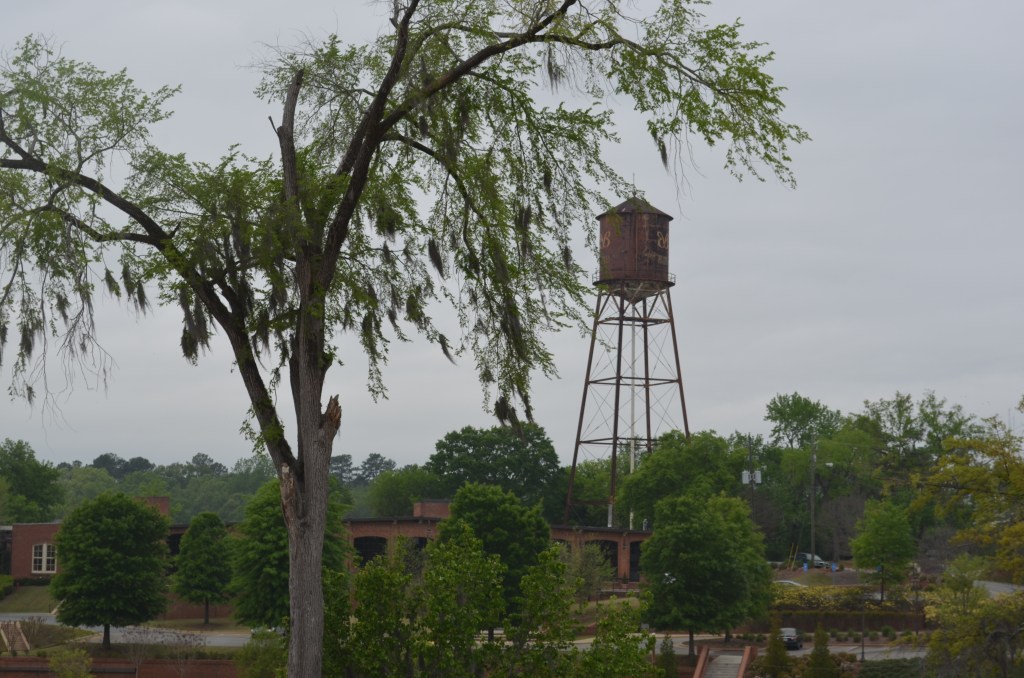
    ‘Bibb City is a ghost town now,’ I whispered. ‘Like the mill, gone are the memories of my youth. I glanced up, wiped a tear while glancing at the Bibb water tower. ‘All that is left are the charred remains of a building where workers strove to make a better life, only to discover the mill controlled and dictated their lives and future. Now, the mill is a ghostly, charred remnant of their hard work. Gone are their footprints and fingerprints.