Tag: mill workers

  • Chattahoochee Child – Bibb City

    Chattahoochee Child – Bibb City


    Bibb City – mid 1960’s

     Papa worked as a loom fitter at Bibb Mill. Wearing Bibb overalls and a denim shirt to work, rarely did he find the freedom or time to take a tobacco chew break. He knew the repercussions if Grammy caught him chewing tobacco; and he realized if he chewed tobacco at the mill someone would tell her. There were no secrets in Bibb City.

    My grandparents lived from pay day, to pay day, thankful to have food on the table and a roof over their heads. Papa lived on a farm before meeting Grammy, planting corn, tobacco and cotton during the day. At night, he raised Hell, drinking moonshine and homemade wine. He had a reputation of trouble and fast times with the women. I’ve often wondered if his reputation was because he was considered a half-breed, because of his Indian heritage.

    Perhaps that is why Papa and I never agreed on anything. He questioned every action taken by me. In retaliation, I rebelled from him and Grammy, asking questions, demanding answers. My philosophy in life was if someone asked a question, they deserved an answer. Papa said children don’t need answers; they need discipline, and a swift pat on the bottom. He had a pet name for me, calling me Little Miss Sassy Fras. I hated being called that and told him so. He simply cackled, mimicking the way I behaved.

    At thirteen, I earned money by babysitting. I rushed to the drug store to buy makeup. Furious with me, Papa found the eye shadow, Maybelline mascara and eyeliner, tossing it in the trash. He said girls who wore makeup were whores. My new nickname was whore. When I told Papa a virgin could not be a whore, he slapped me hard on the face.

    On weekends, Papa took Rusty fishing at the boat club. The boat club was a little fishing club, upstream from the mill, located about twenty miles from where the crow flies in Bibb City.

    Although Papa could fish from the riverbanks by the mill, he chose not to. “The Chattahoochee waters are too muddy,” He said. “We think the mill dumps waste in the waters.”

    The floating dead fish and garbage he saw floating along the crest of the dirty waters was a testament of the pollution.

    Papa’s fishing boat was a small two-seater wooden boat structure, with a small Johnson motor. The boat was not fancy, compared to modern bass boats or ski boats. Papa’s fishing boat was painted a faded pea green color with the words ‘Gone Fishing’ painted in black.


  • Chattahoochee Child

    Chattahoochee Child


    PART TWO

    The headlines in the newspaper caught my attention. Bibb Manufacturing Company becomes a ghost town. I stared at the caption with a tight bewildered look on my face, reading it again, picturing the desolate hope filled community of Bibb City, Georgia, the destitute textile community of my youth. Bibb City was the small cotton mill town where my footprints were imprinted within the clay riverbeds. Bibb City was the only place I had roots established. Bibb City was Home to me.

    The richness of life in a mill town is disappearing now while the little town called Bibb slowly becomes extinct. Bibb Manufacturing Company abandoned the area in 1998, closing the mill, leaving a graveyard of homes, failing businesses, broken families and memories behind. The hunger for better jobs, civil rights, and the race for modern technology prevailed, leaving the Town of Bibb City devastated.

    I poured another cup of coffee, reading the article again. The years of working as a reporter filled my mind with curiosities and questions about the dying communities of mill workers. I scribbled notes on a pad. My mind rushed back to my youth, playing a mental continuous loop video of memories from the small town of Bibb City, Georgia.

    Why was the little town  called Bibb City distressing me? Years ago, I drove away from the Village without looking back, embarrassed to be associated with people who judged others by the colors of skin, religion, sexual preference, or political choice. Sipping a hot cup of coffee, I realized my perspective about Bibb City was changing.

    Reading the article again, my body was shaking. If the mill is no longer in business, what will the residents of this precious mill village do for survival? Bibb Mill provided housing and when the Mill decided to sell those homes to mill workers, many of the hard working employees took their first steps to independence and the American dream — a home — a brick and mortar foundation where roots could remain.  My grandparents became homeowners, buying a tiny brick home on Walnut Street. Grammy  insisted on buying a home so Mom could have a place to live.

    After Grammy’s death, Mom had other ideas. She sold the house, wasting away all of the money. What about the historical value of the Bibb Mill? Couldn’t the politicians see the potential for historical recording? Was everything in the corporate world about the potential for a profit? What about the families who lived in the Village?

    A whirlpool of mixed emotions churned inside me. As I read the article about the abolishment of the town I knew so well, I discovered childhood feelings resurfacing. I debated my anger for a few moments, realizing I could do nothing to stop the bureaucracy of developers, who had no comprehension of the premise of life in a mill town. The one thing I could do was to write about the rise and fall of Bibb Manufacturing Company. As my grandfather reminded me, “You work for the Mill, you’ll always have a job.” Papa died before the Mill closed.

    I called my editor, leaving a voice mail, expressing interest in a story about mill workers. Bibb City would be the focal point. When he returned my call, I pitched the idea.

    “We have to do this story,” I said. “It isn’t just about life in a mill town. It’s a story about relationships, civil rights, bigotry, and so much more. It’s a feature, maybe even a series. We’ll start with The Rise and Fall of The Bibb Manufacturing Company.”

    I waited for his response.

    “Let me think about it.”

    “I need a commitment now,” I pushed aggressively. “I’m packing my bags. There’s a story there and I’m going to get it,” I said. “My mother lives there. She’s had a stroke.”

    “Sounds like you have some issues,” Garrett groaned.

    “A few. If you’re not interested in the story, I’ll find someone else.”

    Garrett laughed. “That’s what I like about you, Rebecca. You always push to the limit.”

    “I’ll call you later,” Garrett breathed into the phone.

    I hung up.


  • Welcome to Bibb City / Columbus, Georgia


    Chattahoochee Child
    Barbie Perkins-Cooper
    Copyright April, 2013

    Arriving in Columbus, Georgia on Wednesday, April 10, 2013, I struggled not to allow depression to overtake my mood. Exhausted from an eight hour drive, I plopped on to the tiny sofa, attempting to relax. “How can I relax,’ I whispered to myself. ‘This is the city that struggled to destroy me.’

    Phil watched a CSI marathon. I chose to bathe. Remembering those troubled years of my youth, when sadness captivated me, I practiced the art of positive thinking. ‘So much of Columbus has changed. This is a different time, a different setting, and now, my mother is gone. She can’t hurt me now…’

    Exhausted, I went to bed, praying silently that this week all will be fine. ‘It’s a new day,’ I said. ‘A new journey. A new chapter.’

    The next morning, Phil and I drove to Bibb City. Phil touched my hand and face and kissed me on the cheek. “It’ll be OK,” he said. “Today is a new day.”

    I smiled. “Those are the exact words I told myself last night.”

    Driving on the roads leading to Bibb City, I exhaled deeply. Wanting only silence, I turned the radio down. My mind drifted back to my childhood in Bibb City.

    The Village my grandparents called Bibb City is framed by the setting of The Bibb Manufacturing Company, a tall brick building with a clock edged into the masonry work. The tiny brick houses in Anderson Village looked the same, with exception of the clutter on many of the porches and around the small lots. The white houses in Bibb City were now painted a variety of colors. Some of the houses were attractive and well cared for; other homes still looked the same, with exception of junk in the yards and the porches cluttered with boxes and other essentials the residents could not store or put away.

    Serving as the focal point of Bibb City during the textile era in America, the Bill Mill dates back to 1920. The Bibb, as elders called the mill, is located on 38th Street and First Avenue.

    The tranquil, close knit mill community called Bibb City encompasses north from 35th Street to 44th Street, and west from Second Avenue to the Chattahoochee River. The streets are narrow and winding. Mill houses consist of approximately 247 dwellings, located within walking distance of the mill. Most are constructed of wood, painted white, landscaped with magnolia trees, sweet gum trees and other varieties, some laced with Spanish moss.

    Bibb City includes the mill acreage along with a smaller area called Anderson Village. The houses in Anderson Village are brick with interior walls of stucco. According to elders who still live in the Village, Bibb City is one of the best planned mill villages ever built, because of the quality of the residential developments and how they were maintained for mill workers. In the 1960’s the mill chose to sell the homes to mill workers. My grandparents jumped at the chance to own a home.

    The dwelling my grandparents bought was located in the middle of Walnut Street, a solid brick structure, containing two small bedrooms, a living room, one miniature bathroom, and a kitchen. The house was less than 1,000 square feet, total living space. Mill workers were accustomed to living in small settlements. ‘We made do with what the Good Lord provided us,’ according to Papa and Grammy.

    The car approached the monstrous skeleton of the remains of Bibb Manufacturing Company. Staring at the entrance, the mill was vacant of mill workers. What remained now was the front entrance standing alone. The mill closed its doors in 1998, leaving fingerprints and footprints of mill workers. In October 2008, the mill burned to the ground.

    I replayed my grandfather’s words when I was a rebellious teenager desperate to break away from Bibb City.

    Papa said, “You stay here. Marry a mill kid and if you want to work, go to work at the mill. Bibb Mill takes care of its workers. All you have to do in life is marry and have babies.”

    My reply, “Bibb Mill makes you a slave…and I don’t want to live my life here. I don’t want to be a baby machine. I want to sing…”

    Papa laughed, placing a piece of Wrigley’s Juicy Fruit gum in his mouth.

    As a child, I was already a feminist!

    I parked the car, grabbed my Nikon digital camera, inhaled…exhaled… My fingers were shaking. Phil remained in the car, downloading software on to his Ipad.

    Clicking my camera, I took several images, recognizing some parts of Bibb City while realizing I had blocked most of the memories away. Gone was the white house where I spent the hot summers with my grandparents. At the site, was an abandoned parking lot. I did not see anyone walking along the sidewalks. Images of mill workers, dressed in Bibb overalls, danced in my mind.

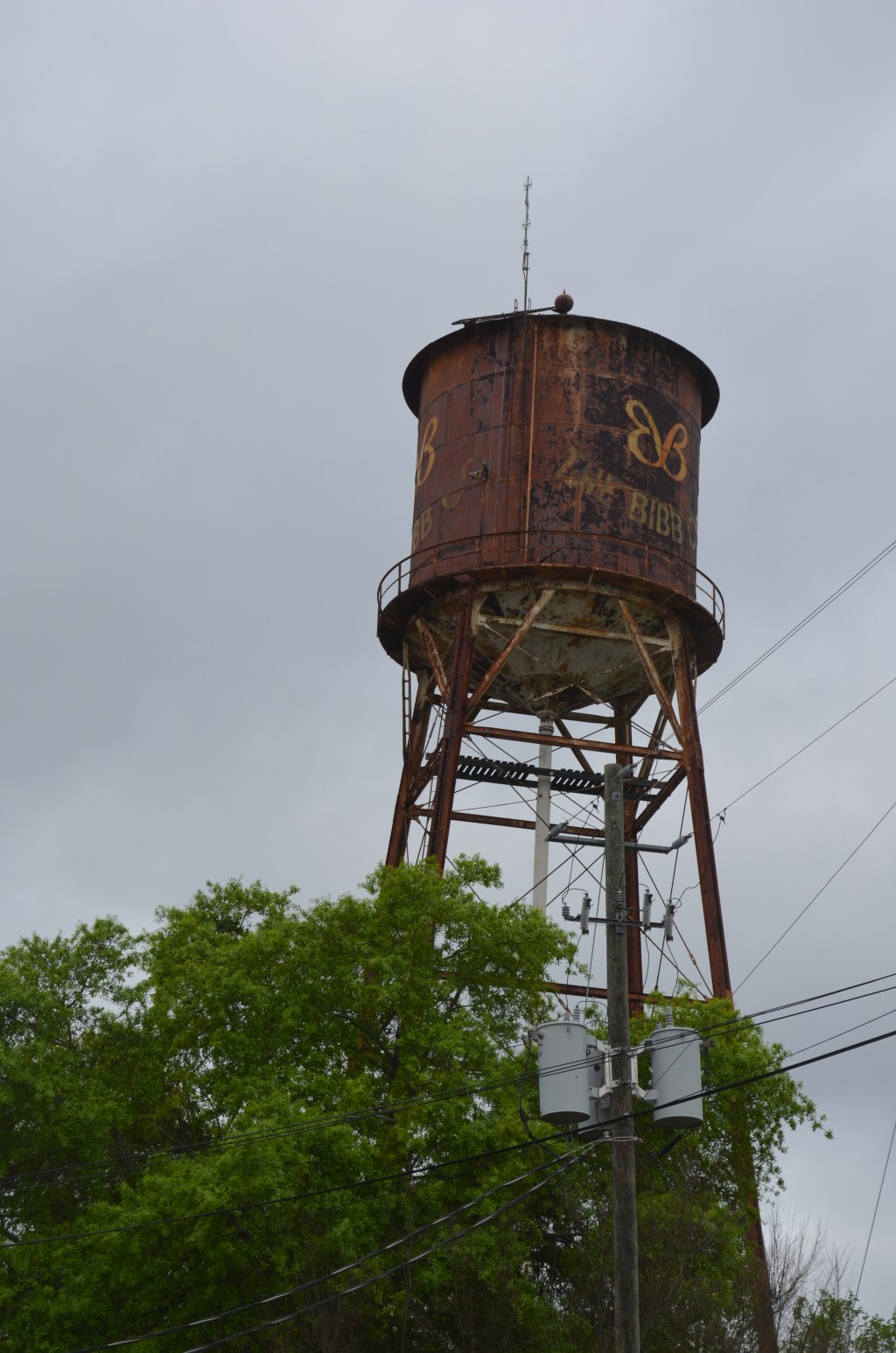
    ‘Bibb City is a ghost town now,’ I whispered. ‘Like the mill, gone are the memories of my youth. I glanced up, wiped a tear while glancing at the Bibb water tower. ‘All that is left are the charred remains of a building where workers strove to make a better life, only to discover the mill controlled and dictated their lives and future. Now, the mill is a ghostly, charred remnant of their hard work. Gone are their footprints and fingerprints.