LIVING IN BIBB CITY
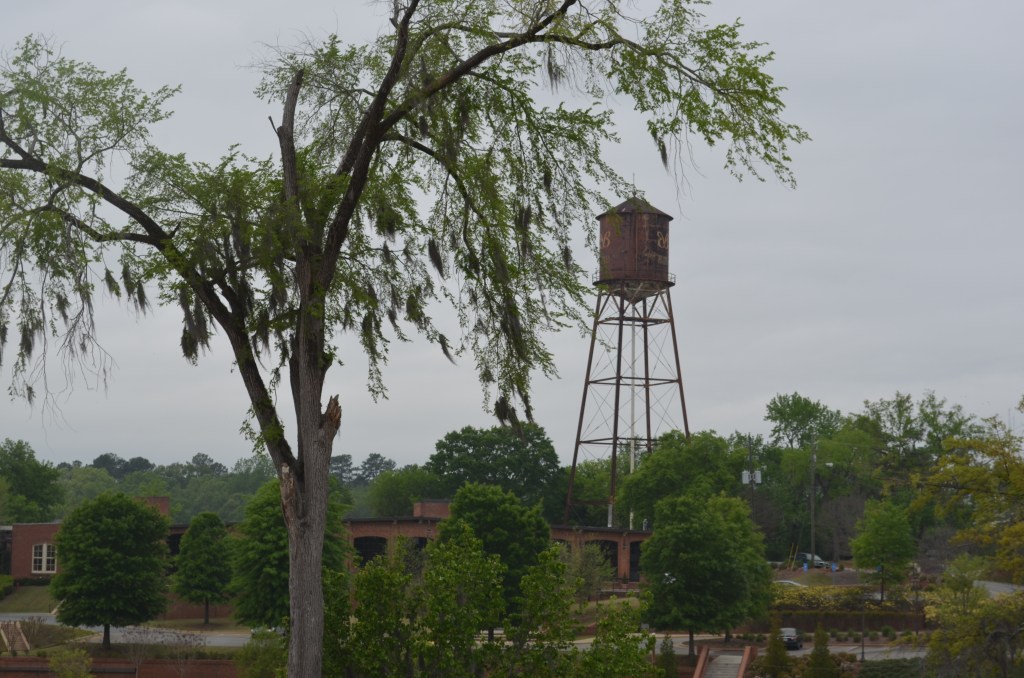
The waters of the Chattahoochee River flow along the riverbanks of Bibb City, a small mill town located on the red clay banks of Columbus, Georgia. The harmonious water trickles in creeks, and rocks; gleaming through thick pine forests, poison ivy and vines.
Sometimes the river is rustic, a reddish-brown terracotta mixture of soil, earth and clay formations. When wet, the Georgia red clay becomes a cluster of mud, forming into shapes human hands can mold into almost anything, drying days later into hardened bricks of earth.
Sitting along the banks of the Chattahoochee River, Bibb City is the kind of old-fashioned town where neighbors speak to each other, knowing more about the walls next door than they know about themselves.
The Village my grandparents called Bibb City is framed by the setting of The Bibb Manufacturing Company, a tall brick building with a clock edged into the masonry work.
Serving as the focal point of Bibb City, the Bill Mill dates back to 1920. The Bibb, as elders called the mill, is located on 38th Street and First Avenue. Houses across the road from the mill are uniform, framed with exterior wood, painted white, sheltering the families of textile mill workers.
The tranquil, close-knit mill community called Bibb City encompasses north from 35th Street to 44th Street, and west from Second Avenue to the Chattahoochee River. The streets are narrow and winding. Mill houses consist of approximately two hundred forty-seven dwellings, located within walking distance of the mill. Most are constructed of wood, painted white, landscaped with magnolia trees, sweet gum trees and other varieties, some laced with Spanish moss.
Bibb City includes the mill acreage along with a smaller area called Anderson Village. The houses in Anderson Village are brick with interior walls of stucco. According to elders who still live in the Village, Bibb City is one of the best planned mill villages ever built, because of the quality of the residential developments and how they were maintained for mill workers.
Mill workers were recruited from blue-collar, unskilled white men and women, and young children. They were treated with respect as long as they followed the rules established by the patriarch Bibb Manufacturing Company while teaching their children to be ‘seen but not heard.’ No one employed by the Bibb questioned the mill’s authority. The domineering practices had the workers moving as if they were under textile mill hypnosis. No one was allowed to speak up, and if they attempted to voice an opinion, they were released. No questions asked. Rarely were blacks hired, and if they were, they were placed in maintenance and not allowed to live in mill housing.
Most of the homes located in the heart of Bibb City had large front porches, built high off the ground, with easy access to the crawl space underneath. When I was a little girl, Grammy and Papa lived in one of the big white houses. I found this convenient for me, choosing to build a cardboard playhouse under Grammy’s house, using large cardboard boxes I found behind Flossie’s Dress Shop as foundations and walls.
My grandparents lived in another white house in the village of Bibb City, until we moved back to live with them temporarily during one hot summer. Papa said Daddy wasn’t a good provider for us. Papa only knew Mama’s side of the story, not the real story.
By that time, the mill wanted to improve working conditions for the workers, so they offered to sell some of the homes.
The dwelling my grandparents bought was located in the middle of Walnut Street, a solid brick structure, containing two small bedrooms, a living room, one miniature bathroom, and a kitchen. The house was less than 1,000 square feet, total living space. Mill workers were accustomed to living in small settlements. We made do with what the Good Lord provided us, according to Papa and Grammy.
Papa bought a metal shed from Sears Roebuck to store fishing equipment, tools and some of Grammy’s sewing supplies that would not fit inside the house. Grammy filled the house with what-knots, lace crocheted doilies, a vinyl couch that made into a bed, crocheted rag rugs, Priscilla curtains, and simplistic pieces of thrift shop furniture. A framed picture of the Lord’s Last Supper hung on the wall over the couch. Family pictures sat on a small, vintage tea cart.
The kitchen contained a small wooden cabinet for Grammy’s mixing bowls, a metal table with four vinyl covered metal chairs, and a gas stove. When our family ate dinner at Grammy’s house, we extended the table with a leaf, so the table could accommodate all of us. I remember crawling underneath the table to get into my seat because the extended table and extra chairs filled the room, since the kitchen was so small. Although simply decorated, the little house on Walnut Street was the only dwelling where I felt completely safe. Little did I know about the City of Columbus, Georgia since we were not permitted to wander away from the boundaries within Bibb City. Papa wanted us to only date mill kids and to never want to do anything else other than church and school. When I ‘painted my face with makeup’ Papa disowned me, telling me I was a ‘painted woman and would die within the gates of Hell.’ I smirked at him. “Papa I already live there…here in Bibb City where I’m not allowed to do anything!”
Yes, I questioned the authority of my Papa and life in Bibb City. I did not wish to be a child that was ‘seen but not heard.’
 Barbie Perkins-Cooper, Author